Tell us about the job
Takes about a minute. No obligation.
Homes in Jefferson County, AR run heat about five months a year, from November through March. Burners, heat exchangers, and ignition assemblies cycle every time the thermostat calls for heat, and after months of that the parts that fail first are rarely the ones a homeowner notices. A contractor pulling a boiler apart here looks at igniter condition, heat exchanger integrity, and burner assembly wear before pricing anything else, because those are the components the season has been running hardest. Sediment in the system and pressure relief behavior tell the same story.
Half the homes in Jefferson County, Arkansas were built in 1978 or earlier (2020-2024 ACS 5-year). A boiler running in a house from that era has likely been serviced through multiple parts generations, and what a contractor finds when they open the unit decides whether the repair is a straightforward fix or a search for components that are no longer stocked. When parts have been discontinued, a contractor sourcing replacements works through specialty suppliers rather than standard distribution, and that changes both what gets ordered and how long the job takes. The building itself is not the constraint. The question is whether the boiler's internal components still have a supply chain behind them.
The Parts of a Boiler a Contractor Checks First
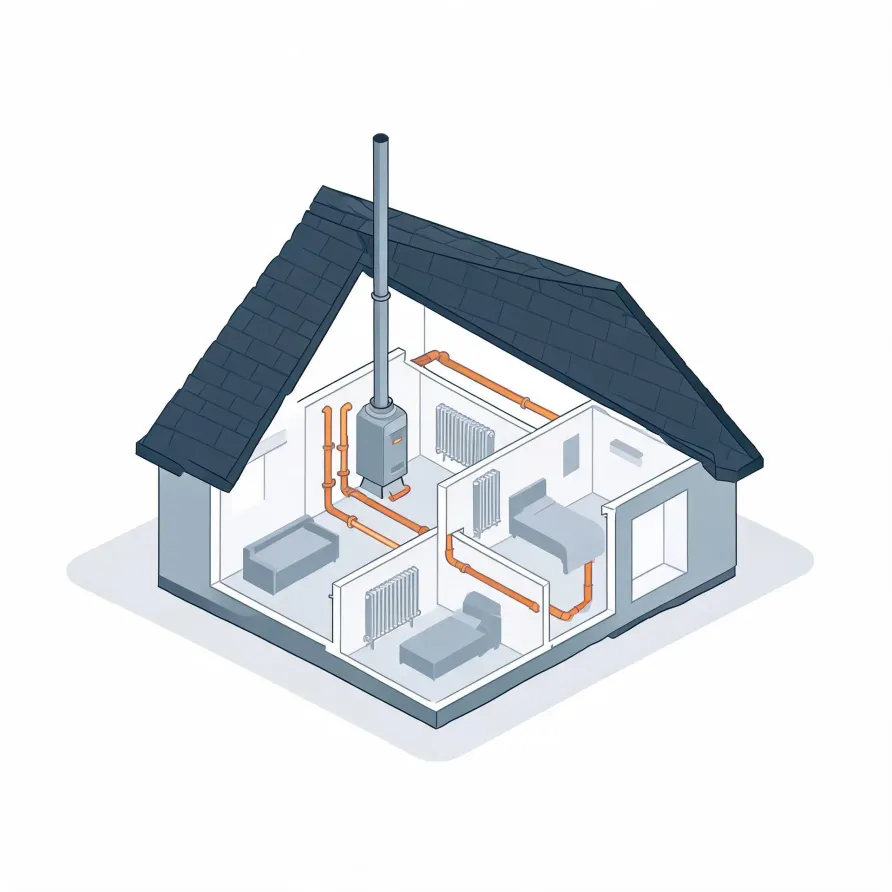
The boiler itself sits in the basement or mechanical room and is the heart of the system. It heats water and pushes it out through the pipes. When heat stops reaching a room or the system short-cycles, the contractor starts here, checking the heat exchanger, burner assembly, and pressure vessel for faults.
The circulator pump moves hot water from the boiler through the distribution pipes to the radiators or baseboard units in each room. The expansion tank, usually mounted close to the boiler, absorbs pressure changes as water heats and cools. Both are common failure points when flow drops or pressure swings out of range.
The drawing shows a typical boiler layout, and a licensed contractor will assess which components apply and what condition they are in for your specific house.
Find a contractor in Jefferson CountyJefferson County, Arkansas, by the numbers
98 severe weather events were recorded in Jefferson County, Arkansas between 2015 and 2024.
NOAA National Centers for Environmental Information, Storm Events Database, bulk CSV export, events 2015-01-01 through 2024-12-31.Half the homes in Jefferson County, Arkansas were built in 1978 or earlier (2020-2024 ACS 5-year).
U.S. Census Bureau, 2020-2024 American Community Survey 5-Year EstimatesJefferson County, Arkansas holds 30,679 housing units (2020-2024 ACS 5-year).
U.S. Census Bureau, 2020-2024 American Community Survey 5-Year EstimatesOwners occupy 61.8% of the occupied homes in Jefferson County, Arkansas (2020-2024 ACS 5-year).
U.S. Census Bureau, 2020-2024 American Community Survey 5-Year EstimatesCodes & Standards Governing Boiler and HVAC Repair in Jefferson County, Arkansas2 sourced rules and standards
Licensing and Legal Requirements in Jefferson County, Arkansas
An Arkansas HVACR licence is good across the state: no city or county may require its own licence to do HVACR work, though local permits and inspections still apply.
Arkansas requires an HVACR licence or registration: it is unlawful to do HVACR work without the appropriate one unless the chapter exempts you.
Severe Weather Events in Jefferson County
Boilers take the hardest hits during the kind of weather that drives heating demand to its peak, and Jefferson County has its own pattern of that pressure. Knowing what the equipment here faces is part of knowing what repair work in this area actually requires.
98 severe weather events, 2015–2024. Source: NOAA National Centers for Environmental Information, Storm Events Database.