Tell us about the job
Takes about a minute. No obligation.
Boiler repair in Pike County starts with the components that do the most cycling: the burner, the ignition assembly, and the heat exchanger. Homes in Pike County, AR run heat about six months a year, from November through April. A contractor diagnosing a repair here checks those parts before anything else, because they accumulate wear with every firing cycle across a season that spans most of the cold half of the year. Seals and expansion joints fail from repeated thermal stress. A boiler that ran hard last winter and sat through summer may surface its faults on the first cold night of November, which is exactly when a technician's schedule fills.
Boilers in Pike County's older housing have frequently been repaired before, and what a contractor finds inside the unit shapes the whole job. Half the homes in Pike County, Arkansas were built in 1984 or earlier (2020-2024 ACS 5-year). A heat exchanger that has been patched, a control board swapped with whatever was available at the time, or a pressure relief valve that has cycled through multiple winters all change what the repair actually requires. Parts availability for equipment in stock this age is the real variable: some components are still made, some exist only as salvage, and a contractor has to confirm which before a repair scope is firm.
The Parts of a Boiler a Contractor Checks First
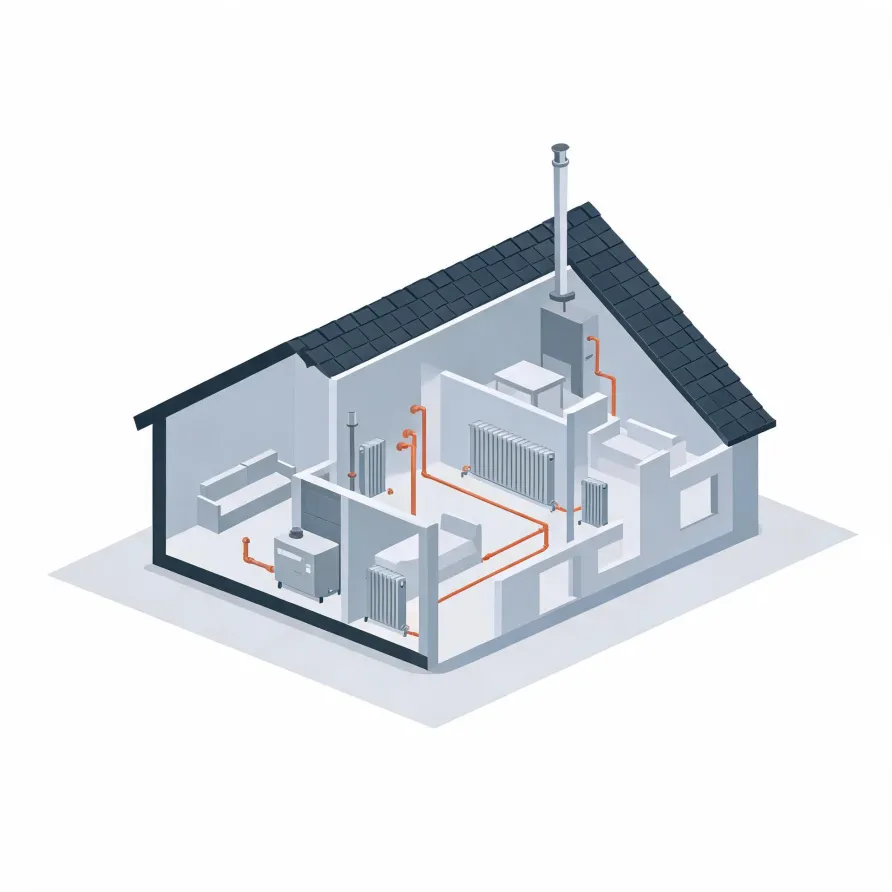
The boiler itself sits in the basement or a mechanical room and is the piece a contractor goes to first when something is wrong. Inside it, the heat exchanger and the burner assembly are where most failures show up. A cracked heat exchanger, a dirty or misfiring burner, or a failed igniter will each stop the system in different ways.
The circulator pump moves heated water out through the supply pipes and draws cooler water back through the return lines. The expansion tank, pressure relief valve, and zone valves sit alongside the boiler and regulate pressure and flow. When a zone goes cold or pressure readings run off, these are the components a contractor traces through.
The drawing shows a general layout of how these parts relate to one another, and a licensed contractor determines what applies to the specific setup in your home.
Find a contractor in Pike CountyPike County by the numbers
42 severe weather events were recorded in Pike County, Arkansas between 2015 and 2024.
NOAA National Centers for Environmental Information, Storm Events Database, bulk CSV export, events 2015-01-01 through 2024-12-31.Half the homes in Pike County, Arkansas were built in 1984 or earlier (2020-2024 ACS 5-year).
U.S. Census Bureau, 2020-2024 American Community Survey 5-Year EstimatesPike County, Arkansas holds 5,324 housing units (2020-2024 ACS 5-year).
U.S. Census Bureau, 2020-2024 American Community Survey 5-Year EstimatesOwners occupy 75.0% of the occupied homes in Pike County, Arkansas (2020-2024 ACS 5-year).
U.S. Census Bureau, 2020-2024 American Community Survey 5-Year EstimatesCodes & Standards That Apply to Boiler Repair in Pike County, Arkansas2 sourced rules and standards
Licensing Rules for HVAC Repair in Pike County, Arkansas
An Arkansas HVACR licence is good across the state: no city or county may require its own licence to do HVACR work, though local permits and inspections still apply.
Arkansas requires an HVACR licence or registration: it is unlawful to do HVACR work without the appropriate one unless the chapter exempts you.
Severe Weather Events in Pike County
Boilers in Pike County work against whatever the climate puts on them, and that load adds up over time. Stress from hard weather shortens equipment life and makes repairs more likely, which is why local weather history is part of the picture for any boiler service here.
42 severe weather events, 2015–2024. Source: NOAA National Centers for Environmental Information, Storm Events Database.