Tell us about the job
Takes about a minute. No obligation.
On a boiler repair call in Drew County, a contractor starts with the burner assembly and the ignition system before anything else. Homes in Drew County, AR run heat about five months a year, from November through March. Every cycle of that heating season puts heat stress and carbon buildup on the burner, and the ignition system fires each time the thermostat calls. By the time a homeowner notices a fault, those parts have already absorbed a full season's worth of starts and shutdowns. A contractor who skips straight to the heat exchanger without checking the ignition components first is working out of order.
Half the homes in Drew County, Arkansas were built in 1985 or earlier (2020-2024 ACS 5-year). A boiler running in a house that old is likely carrying components whose part numbers have narrowed or dropped from supplier catalogs entirely. When a contractor opens the unit, the question shifts from what is wrong to whether what is wrong can still be sourced. Fired heat exchangers, zone valves, and pressure relief assemblies from that generation of equipment sometimes have to be matched to manufacturer archives rather than current stock, and that search decides how the job is quoted and how long it runs.
The Parts of a Boiler a Contractor Checks First
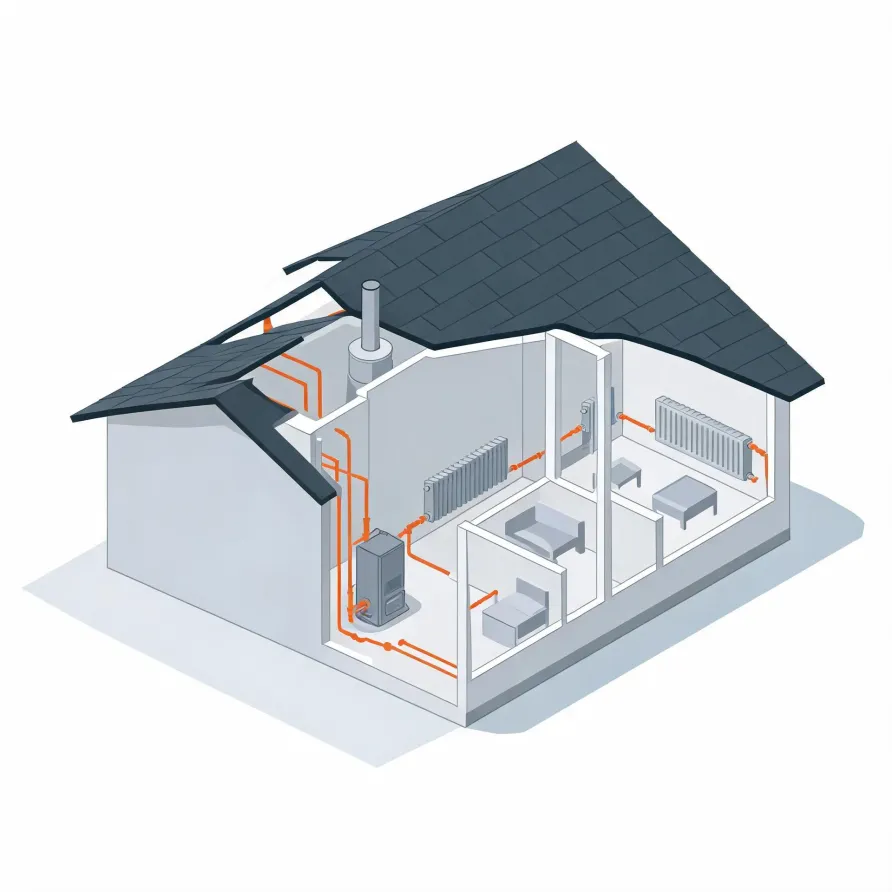
The boiler itself sits in a mechanical room, basement, or utility closet and is the piece a contractor goes to immediately when something is wrong. Inside it, the heat exchanger and the burner assembly are the first suspects when a system stops producing heat or behaves erratically. The circulator pump, mounted directly on the boiler or on a supply line nearby, moves heated water through the system and is checked when heat reaches some rooms but not others.
The expansion tank, usually hanging from a pipe close to the boiler, absorbs pressure changes as water heats and cools. Radiators, baseboard convectors, or radiant floor manifolds sit throughout the house and are where a contractor confirms whether a problem is at the source or somewhere along the distribution side. The pressure relief valve and the thermocouple or flame sensor are smaller components on or near the boiler body that draw attention when shutdowns or ignition failures are the complaint.
The drawing shows a general layout of these components, and a licensed contractor determines which parts apply and what condition they are in for this specific house and system.
Find a contractor in Drew CountyDrew County, Arkansas, by the numbers
75 severe weather events were recorded in Drew County, Arkansas between 2015 and 2024.
NOAA National Centers for Environmental Information, Storm Events Database, bulk CSV export, events 2015-01-01 through 2024-12-31.Half the homes in Drew County, Arkansas were built in 1985 or earlier (2020-2024 ACS 5-year).
U.S. Census Bureau, 2020-2024 American Community Survey 5-Year EstimatesDrew County, Arkansas holds 8,289 housing units (2020-2024 ACS 5-year).
U.S. Census Bureau, 2020-2024 American Community Survey 5-Year EstimatesOwners occupy 63.7% of the occupied homes in Drew County, Arkansas (2020-2024 ACS 5-year).
U.S. Census Bureau, 2020-2024 American Community Survey 5-Year EstimatesBoiler Repair Rules on the Books for Drew County, Arkansas2 sourced rules & standards
Licensing and Legal Requirements in Drew County, Arkansas
An Arkansas HVACR licence is good across the state: no city or county may require its own licence to do HVACR work, though local permits and inspections still apply.
Arkansas requires an HVACR licence or registration: it is unlawful to do HVACR work without the appropriate one unless the chapter exempts you.
Severe Weather Events in Drew County
Boilers in Drew County take the full brunt of whatever the climate delivers, and that workload accumulates across years. Repair needs here are shaped by local conditions, and the record below shows what those conditions have looked like.
75 severe weather events, 2015–2024. Source: NOAA National Centers for Environmental Information, Storm Events Database.