Tell us about the job
Takes about a minute. No obligation.
A boiler repair in Newton County starts with the burner assembly and heat exchanger, because those are the parts that cycle every time the system fires. Homes in Newton County, AR run heat about seven months a year, from October through April. That sustained runtime shows up as cracked heat exchangers, fouled burners, and worn ignition components before it shows up anywhere else on the unit. A contractor quoting a repair here prices those parts first, not last.
Half the homes in Newton County, Arkansas were built in 1983 or earlier (2020-2024 ACS 5-year). A house carrying a boiler through that many rounds of adaptation tends to have a distribution system that has been modified, extended, or partially replaced over the years, and those changes are what shape a repair more than the boiler itself. Piping runs that were rerouted, zone valves added after the original install, radiators swapped out at different points: a contractor opening up the system in a house like this is diagnosing what several eras of work have left behind, not a single original configuration. What they find in that piping decides whether the fix is contained or whether it pulls in adjacent work.
The Parts of a Boiler a Contractor Checks First
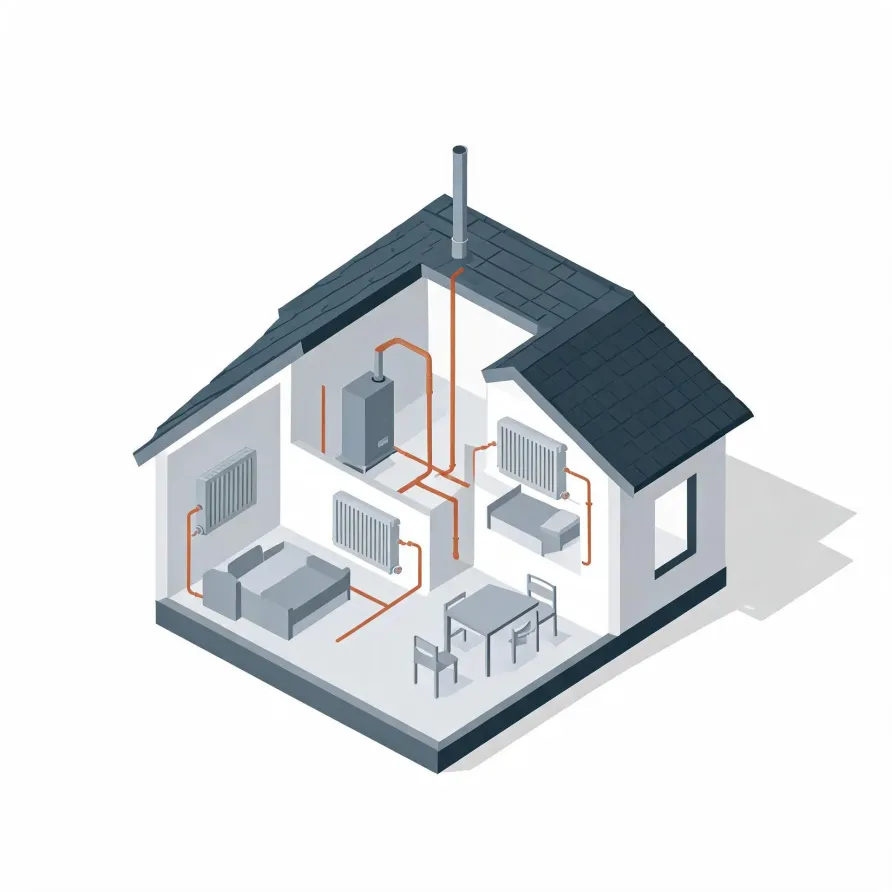
The boiler itself sits in the basement or a mechanical room and is the piece a contractor goes to first. It heats water and pushes it through the system. When heat stops reaching the rooms, or pressure drops, or the unit cycles on and off without settling, the boiler is where the diagnosis starts.
From the boiler, pipes carry hot water to radiators or baseboard units spread through the living spaces. The circulator pump moves water through those pipes, and the expansion tank absorbs pressure changes as water heats and cools. A failed pump or a waterlogged expansion tank each produce symptoms that look like a boiler problem until a contractor rules them out.
The drawing shows a general layout of these components, and a licensed contractor determines what applies to the specific system in your house.
Find a contractor in Newton CountyNewton County, Arkansas, by the numbers
57 severe weather events were recorded in Newton County, Arkansas between 2015 and 2024.
NOAA National Centers for Environmental Information, Storm Events Database, bulk CSV export, events 2015-01-01 through 2024-12-31.Half the homes in Newton County, Arkansas were built in 1983 or earlier (2020-2024 ACS 5-year).
U.S. Census Bureau, 2020-2024 American Community Survey 5-Year EstimatesNewton County, Arkansas holds 4,099 housing units (2020-2024 ACS 5-year).
U.S. Census Bureau, 2020-2024 American Community Survey 5-Year EstimatesOwners occupy 76.5% of the occupied homes in Newton County, Arkansas (2020-2024 ACS 5-year).
U.S. Census Bureau, 2020-2024 American Community Survey 5-Year EstimatesCodes & Standards Behind Boiler Repair in Newton County, Arkansas2 sourced rules and standards
What Newton County, Arkansas Requires for HVAC Repair Work
An Arkansas HVACR licence is good across the state: no city or county may require its own licence to do HVACR work, though local permits and inspections still apply.
Arkansas requires an HVACR licence or registration: it is unlawful to do HVACR work without the appropriate one unless the chapter exempts you.
Severe Weather Events in Newton County
Boilers in Newton County work against whatever the local climate demands, and storm activity is part of that load. Repair needs here are shaped by local conditions, not regional averages.
57 severe weather events, 2016–2024. Source: NOAA National Centers for Environmental Information, Storm Events Database.