Tell us about the job
Takes about a minute. No obligation.
Sizing a boiler for this house is not a task a contractor can handle with a rule of thumb. Homes in Craighead County, AR run heat about seven months a year, from October through April. The burner and heat exchanger cycle through that entire stretch, and a unit that is undersized runs longer at each call for heat, accelerating wear on the ignition system and the seals around the combustion chamber. A contractor who skips a proper load calculation before installation leaves the homeowner with a system that is fighting its own capacity every winter.
Older electrical service panels in this part of Arkansas were sized for loads that modern boiler systems routinely exceed, and a contractor quoting a new boiler has to put that ahead of everything else. Half the homes in Craighead County, Arkansas were built in 1992 or earlier (2020-2024 ACS 5-year). A house built to that era's electrical standards often carries a panel that cannot support what a replacement system draws, and the panel work that follows reshapes the total job cost before anyone prices the boiler itself.
What a Boiler Installation Covers
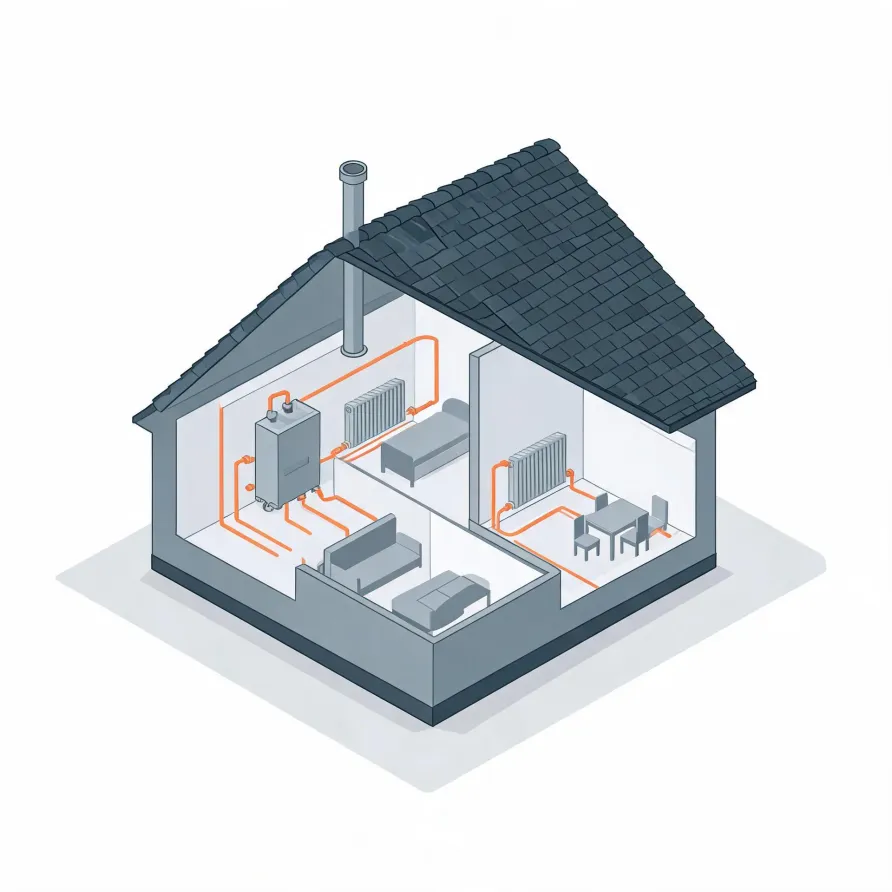
The boiler itself sits in a mechanical room, basement, or utility closet and is the heart of the system. A contractor mounts it to the floor or wall, connects it to the fuel supply, and ties it into the home's piping. That piping runs hot water out to the heat emitters and returns cooler water back.
The heat emitters, whether baseboard units, radiators, or radiant floor loops, sit throughout the living spaces and are where warmth actually enters the rooms. A circulator pump, typically mounted close to the boiler, keeps water moving through the loop. An expansion tank and pressure relief valve sit nearby as well, managing pressure as the water heats.
The drawing shows a typical boiler layout, and a licensed contractor determines exactly which components and configurations apply to your home.
Find a contractor in Craighead CountyCraighead County, by the numbers
177 severe weather events were recorded in Craighead County, Arkansas between 2015 and 2024.
NOAA National Centers for Environmental Information, Storm Events Database, bulk CSV export, events 2015-01-01 through 2024-12-31.Half the homes in Craighead County, Arkansas were built in 1992 or earlier (2020-2024 ACS 5-year).
U.S. Census Bureau, 2020-2024 American Community Survey 5-Year EstimatesCraighead County, Arkansas holds 48,885 housing units (2020-2024 ACS 5-year).
U.S. Census Bureau, 2020-2024 American Community Survey 5-Year EstimatesOwners occupy 60.1% of the occupied homes in Craighead County, Arkansas (2020-2024 ACS 5-year).
U.S. Census Bureau, 2020-2024 American Community Survey 5-Year EstimatesBoiler Installation Rules on the Books for Craighead County, Arkansas2 sourced standards and codes
Licensing and Legal Requirements in Craighead County, Arkansas
An Arkansas HVACR licence is good across the state: no city or county may require its own licence to do HVACR work, though local permits and inspections still apply.
Arkansas requires an HVACR licence or registration: it is unlawful to do HVACR work without the appropriate one unless the chapter exempts you.
Severe Weather Events in Craighead County
Boiler installations in Craighead County work against whatever the climate delivers, and weather stress is one of the real factors behind how hard a system runs and how long it holds up. A boiler sized and installed for local conditions performs differently than one that is not.
177 severe weather events, 2015–2024. Source: NOAA National Centers for Environmental Information, Storm Events Database.